

As Pakistan seeks to become a thriving economy in 2047, efforts to accelerate progress in human capital development will be essential.
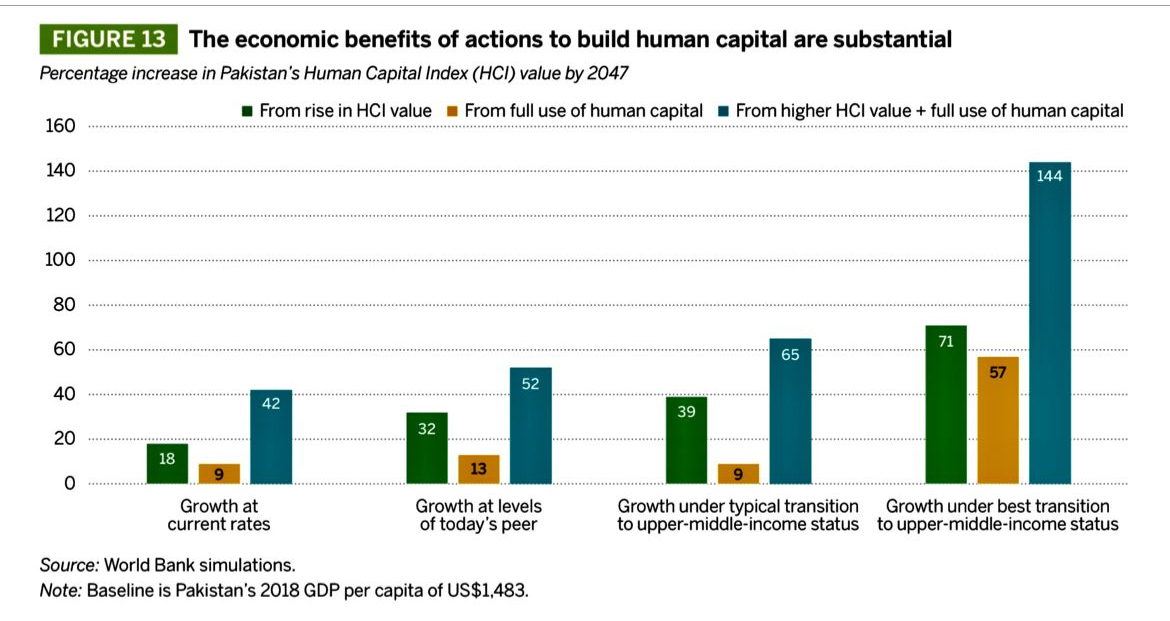
Simulations of several realistic scenarios show how much Pakistan’s economic productivity could increase by investing more in human capital over the next 25 years—to 2047, the 100th anniversary of its founding.
- Business as usual: If Pakistan continues to improve its human capital index (HCI) value at the current rate, its GDP per capita is expected to grow by a mere 18 per- cent by 2047.
- Matching its current peers: If it can boost its HCI value to the level of its peers, its per capita GDP could grow by 32 percent by 2047.
- Matching the average lower-middle-income country advancing to upper-middle-income status: If it can improve its HCI value at the same rate as an average country that transitions from lower-middle-income status to upper-middle- income status, which Pakistan aspires to, its GDP per capita would rise by 39 percent.
- Matching the best performing lower-middle- income country having advanced to upper- middle-income status: If it can improve both its human capital and its use of human capital, bringing adults into productive work outside farming, its GDP per capita would rise by 144 percent, eight times more than under business as usual.
The onus is on policy makers, opinion makers, and all other stakeholders to work together not only to develop the country’s human capital but also ensure its productive utilization.
(adapted from World Bank Group, 2022)
 South Asian Academy of Management