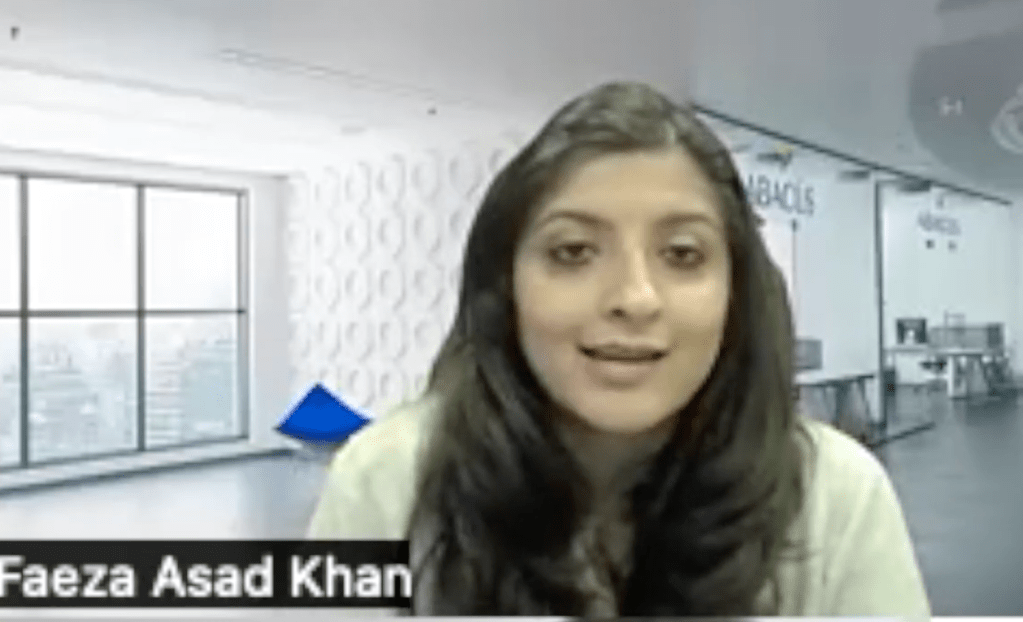
Event: “What Can CEOs Do to Foster Women’s Leadership and Drive Organizational Success?” – Webinar by South Asian Academy of Management (SAAM) – 22 January 2025
Speaker: Faeza Asad Khan, Chief Strategy Officer, Abacus
Synposis
In this reflective conversation, Faeza Asad Khan discusses the gendered challenges women face in Pakistan’s professional and social spheres. She highlights how domestic responsibilities and community expectations continue to disproportionately fall on women, despite their increasing participation in the workforce. Emphasizing the importance of early education, she advocates for embedding leadership and soft skills—such as confidence, communication, and emotional intelligence—within school curricula to nurture young girls’ potential. Drawing from personal and professional experiences, including leadership programs and workplace dynamics, she illustrates how unconscious biases—especially around assertive behavior in women—persist in hiring and negotiation contexts. She also underscores the need for male allies, sensitivity in organizational culture, and emotionally intelligent leadership to enable more inclusive and equitable workplaces.
Traanscript
Work Family Balance
It’s actually being recognized, sometimes from your peers and colleagues. Especially in Pakistan, we are a little behind the curve. Like in other countries, as women get more involved in the workplace, the shared responsibility for domestic care ends up being divided. Whereas in Pakistan, the burden is still very firmly resting with women. We are also a society that is very connected—it’s a blessing in a way—but with that connection comes a lot of social protocol, pressure, and the need to be visible in community events. That can bring its own set of challenges, and the burden again falls on women. People are much more understanding and forgiving of men not matching those expectations, even socially.
Cultural Transformation
With women, even if someone knows you’re a working woman, the expectations can be different. So it is a challenge. I agree that change happens right from your schooling. It’s about raising awareness, setting up curriculum in a way that supports people to think differently. Once you’re 35 or 40, you’re set in your ways, and it’s very difficult to change someone at that age. From schooling onward, it’s hard for corporates to intervene in personal lives—that’s a stretch. But one can do awareness-raising campaigns. Men who are more proactive can serve as role models for their community.
In my previous role at a large nonprofit—focused on reproductive health—we had male champions hold dialogues with peers and friends to influence attitudes. So there are initiatives that can be taken, but they must be handled sensitively. It’s not easy; we’re culturally quite set in our ways. Yet Pakistan is a mixed bag. There are people transitioning to embodying shared values, while others remain very traditional in their views.
I agree that women should be encouraged to be leaders at a younger age. Schooling plays a big part. We have structural and cultural challenges, but that’s where schools and institutions—with the right curriculum—can serve as influencers early on. Leadership also depends on confidence—your ability to express yourself, to demonstrate your talents—and that confidence can be nurtured in schools. We need to encourage youth to speak out and set healthy boundaries.
Expressing respectfully while still being assertive
In my own trajectory, one thing I had to learn was how to speak appropriately. Most of my career has been outside Pakistan, but culturally, we come from a place where we’re taught to be very respectful toward elders and seniors. That’s a good thing. However, I’ve worked in places where you still need to voice your opinion—bring your ideas to the table. You can’t just say, “They are senior to me, so what they say is gospel.” You have to move beyond that. Expressing yourself respectfully while still being assertive is a learned skill.
These are soft skills, and many of our institutions are beginning to recognize that. Often, we groom our talent academically, but not in terms of soft skills. At university, students might do brilliantly, but they’re not workplace-ready. Some ventures in Pakistan are trying to fill that gap between academic learning and soft skill development. These are learned behaviors that can be influenced at the right time—ideally in school, but also in the workplace with the right messaging.
I agree that we need more campaigns that encourage people to speak out and voice opinions respectfully. When women become confident in doing this, they can become champions for other women. The culture of competitiveness among women in the workplace is changing, and now we see more female champions supporting each other, which is encouraging.
Bias
Bias—both conscious and unconscious—also plays a role in how women’s behaviors are perceived. I was involved in an executive course on female leadership, and one example that stuck with me was from a Harvard study. When organizations are about to hire someone, if the candidate is male and negotiates, it doesn’t impact perception. But if a woman negotiates, she is more likely to be perceived as difficult to work with. Equal pay for equal work is important, and negotiation is part of that. Yet, when women negotiate, they are judged differently. That’s where awareness, mentorship, and male allies are key.
We should encourage women to become their own champions, and normalize that. Often, when women advocate for themselves, they are seen as difficult. It’s a loop, and male allies play an important role in breaking it.
Emotional Intelligence
In corporate culture, emotional intelligence (EI) is increasingly valued—even more than IQ in some cases. Regardless of gender, EI helps people move forward. When I started my career, I struggled to understand how to navigate large organizations and demonstrate capability. A female manager once advised me to “act into” the role I aspired to. Instead of waiting for promotion, begin to step into those responsibilities. That approach helps the manager step up, and also showcases your readiness. It’s not just about tasks; it’s about understanding team dynamics—how to support your peers, juniors, seniors, clients—how to make their work easier. That kind of emotional intelligence can’t be underestimated.
Coming into work and simply completing your assigned tasks might tick a box, but it won’t provide a platform for growth. Women tend to have stronger EQ, which is a strength. Sometimes it can lead to over-empathy, which might be a disadvantage in certain settings, but when balanced well with IQ, it becomes a powerful asset.
Positive Action
As for hiring decisions, I think it depends on the organizational need. I agree with the view that women have been so unfairly disadvantaged that some positive discrimination may be necessary to help them catch up. At the same time, if there’s an urgent business need, there are temporary solutions—a short-term hire, or someone filling the gap internally—until the preferred candidate is available. If the female candidate is the right one, we should wait and give her the opportunity.
I’ll share a personal story. I was working in London and applying for jobs. During one interview, I was 30 minutes late due to overwhelming pressure at my previous job. Despite that, the organization said I was the best candidate. They needed someone immediately, but because I had some paperwork to finalize, they had to wait a couple of months. They chose to wait. That was a positive signal—it showed that prioritizing the right fit, even in urgent situations, pays off in the long run.
Indicative Discussion Questions
- The speaker (Faeza Asad Khan) describes how cultural norms in Pakistan often hold working women to different social expectations than men. How can organizations and communities begin to challenge these norms without alienating traditional values?
- Drawing from the Harvard study mentioned in the video, how do perceptions differ when women negotiate for salaries or benefits compared to men? What practical steps can organizations take to create a bias-aware performance and negotiation culture?
- The speaker shares how early schooling and curriculum design can shape confidence and leadership potential, especially for girls. What specific elements (e.g., activities, subjects, role models) should schools include to foster these capabilities from a young age?
Copyright and Permissions: © South Asian Academy of Management. An inspection copy of this article is available free of cost at this site. For classroom use or to order copies or request permission to reproduce materials, email: info@southasianaom.org OR call (+92) 3291009981. This publication may not be digitised, photocopied, or otherwise reproduced, posted, used or transmitted, without the permission of South Asian Academy of Management.
 South Asian Academy of Management