Synopsis
In this guest talk, Aqeela Bano, CEO of CIQAM, a women’s social enterprise in Hunza, shares the remarkable journey of an initiative that began in 2003 under Aga Khan Cultural Services Pakistan (AKCSP). Starting with the restoration of Altit Fort, CIQAM has challenged conventional gender norms by training and employing local women in traditionally male-dominated fields such as carpentry, masonry, surveying, plumbing, and electrical work, while later expanding into hospitality, music, and other enterprises.
Drawing on her own journey from a 17-year-old trainee to a professional surveyor and organisational leader, Aqeela highlights the societal resistance faced by women entering technical professions and offers a powerful conception of women’s empowerment based on equal rights, meaningful opportunities, economic independence, and the freedom to pursue one’s aspirations. She also discusses CIQAM’s commitment to environmental sustainability through green timber, reforestation, traditional construction techniques, and climate-conscious development.
The talk extends beyond CIQAM to critically examine some of the wider challenges facing Hunza and Gilgit-Baltistan, including uncontrolled tourism and construction, environmental degradation, the decline of local languages and cultural heritage, gaps between theoretical education and practical skills, youth unemployment and frustration, and restrictive gender norms. Aqeela calls upon universities, government, local communities, tourists, and young people to promote responsible tourism, sustainable development, practical and technical education, cultural preservation, and respectful gender relations.
Overall, the talk presents CIQAM as a compelling example of how a locally rooted social enterprise can simultaneously advance women’s empowerment, gender equality, environmental sustainability, cultural preservation, skills development, and community resilience.
Intended Learning Outcomes (ILOs)
By the end of this discussion, participants should be able to:
- Evaluate the role of social enterprise in advancing women’s empowerment and gender equality.
- Examine the social, cultural, and environmental challenges associated with tourism and development in Gilgit-Baltistan.
- Assess the importance of practical education, skills development, and cultural preservation for sustainable communities.
- Recommend actions for promoting responsible tourism and environmentally sustainable development.
Speaker: Aqeela Bano
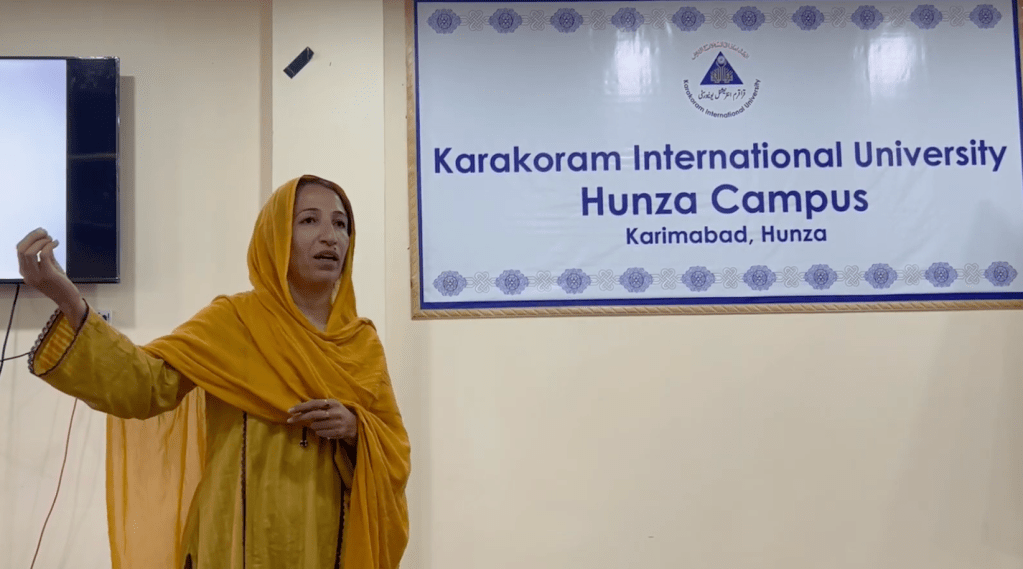
Moderators: Dr Syed Zahoor Hassan and Dr Jawad Syed
Event: NBEAC Deans Development Program
Venue: KIU, Karimabad Campus, Hunza.
Link to full video: https://www.youtube.com/watch?v=7f_KydfktrU
Duration: 48 minutes
Date: 24 Aug 2023
Citation: Bano, A (2026). Women’s social enterprise in Hunza, Gilgit Baltistan – Case of Ciqam: Aqeela Bano. South Asian Academy of Management.
About the Speaker
Aqeela Bano is the CEO of CIQAM (women’s social enterprise) at Hunza, a project of Aga Khan Cultural Services Pakistan (AKCSP). In this guest speech at the Deans Development Program (DDP) at Hunza (on 23-24 Aug), she offers an overview of Ciqam, “Ciqam” is a Brushiski word that means “greenery”, but it also means growth and prosperity. Ciqam was created in 2003 and is located outside the Altit Fort in the Hunza Valley of Northern Pakistan. The project was developed under Aga Khan Cultural Services Pakistan (AKCSP) and is also funded by the Norwegian Embassy Trust for Culture. Its aim is to economically empower local women, so they can contribute and earn from the industries present in the region. It trains women in the art of carpentry and stone masonry, occupations which are normally associated with men. Since its inception, the project has established itself in the area and has had tremendous growth. Now along with carpentry, these women also run their own restaurant, music school, and guest house, all of which they built themselves.
Discussion Questions
- What were the key challenges faced by CIQAM in empowering women in traditionally male-dominated occupations in Hunza and other areas?
- How can social enterprises balance economic viability with social, cultural, and environmental goals?
- What responsibilities do tourists, local communities, businesses, and the government have in promoting responsible and sustainable tourism in Gilgit Baltistan?
- How can uncontrolled tourism and commercial development affect the environment, culture, and social fabric of Gilgit-Baltistan?
- What role can universities and educational institutions play in promoting practical skills, cultural preservation, and sustainable development?
- How can women’s empowerment be advanced without reinforcing gender segregation or restrictive interpretations of culture?

