
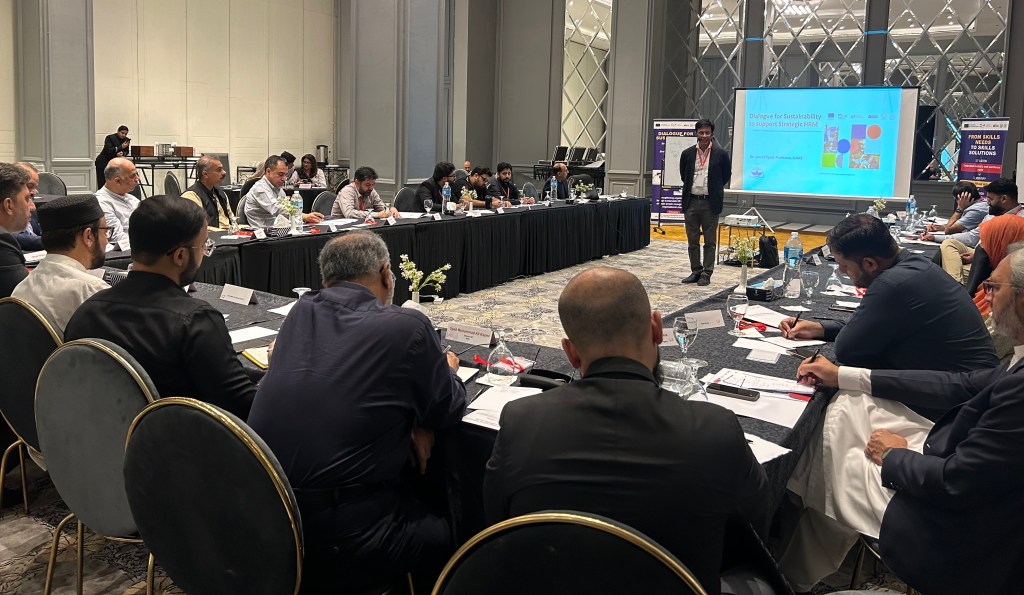
Over the past 12–18 months, my colleagues and I visited 55 companies across eight economic sectors in Punjab and Khyber Pakhtunkhwa as part of the GIZ–LUMS project. We met with HR departments and practitioners to understand their capacity, influence and approach to key people-management responsibilities.
In Pakistan, political debate has often featured competing calls: “Vote ko izzat do”—respect the vote—and “Voter ko izzat do”—respect the voter. Within the HR profession, a quieter appeal has also persisted: “HR ko izzat do”—respect HR.
But before asking for respect, HR must ask itself a harder question: What would enable it to command the respect of the C-suite, colleagues and employees?
Allama Iqbal’s words offer a fitting challenge:
ہو صداقت کے لیے جس دل میں مرنے کی تڑپ
پہلے اپنے پیکرِ خاکی میں جاں پیدا کرے
Translation: “If a heart longs to give its life for truth, it must first bring its own earthly form to life.”
In HR’s context: Before asking organisations to respect HR, the profession must strengthen its own capability, credibility and contribution.
The visits suggested that HR’s claim to respect had to be matched by professional capability, business understanding and a demonstrable contribution to organisational priorities.
Professional capability and credibility. We found concerns about HR practitioners’ HR-related qualifications, professional certification and understanding of the discipline itself. In some organisations, HR practitioners’ capacity appeared too limited to support the full range of contemporary HR responsibilities. Strengthening the profession would require more than assigning people to HR roles: practitioners needed relevant knowledge, continuing development and the authority to apply what they knew.
Strategic understanding and influence. HR was not consistently involved in strategic planning or represented in senior decision-making. Our observations raised questions about whether HR practitioners fully understood their company’s business strategy, SWOT, competitors, strategic objectives, workforce requirements, pain points and cash cows. HR also needed to show how its own policies and plans supported the company’s long-term strategy. That meant participating in strategic discussions and aligning HR strategy with organisational priorities—not simply responding after decisions had been made.
Recruitment and senior appointments. HR’s influence over recruitment, especially for senior roles, appeared limited in some companies. A familiar quip about the United Nations says that when two weak countries have a dispute, the dispute disappears; when a powerful country and a weak country are involved, the weaker one disappears; and when two powerful countries disagree, the UN disappears.
At times, HR seemed to face a similar predicament. In some family-owned businesses we visited, the CEO made senior appointments directly, while HR’s role came closer to conveying the decision than shaping it. HR could resemble a post office: part of the process, but with little influence over its outcome. This limited role also raised questions about the consistency and rigour of senior recruitment.
Employee voice and engagement. Independent employee-engagement processes were almost entirely absent. Without credible, confidential ways to understand employees’ views, organisations had limited insight into how people experienced communication, fairness, supervision, workload and development. Giving employee voice due recognition is essential if HR is to act as an employee champion in practice.
Performance, feedback and rewards. Performance-management systems were deficient, and performance appraisal was not adequately connected to reward management. Appraisal needs to do more than record a rating: it should support meaningful feedback, development and fair recognition. The visits highlighted the need for clearer performance expectations, better feedback processes and a more transparent relationship between performance and rewards.
Training and development. Training budgets were absent or negligible in many cases, and the basis for training investment was often unclear. Training needed to be connected more deliberately to strategic priorities, job requirements and capability gaps. Organisations also needed to assess whether learning was being applied at work and contributing to improved performance.
Taken together, these findings showed a gap between the contribution expected of HR and the qualifications, capacity, influence and resources available to deliver it. The responsibility is shared. HR practitioners need to build professional credibility and demonstrate business value; organisational leaders need to involve HR in strategy and give it the mandate to contribute.
The visits also reinforced the case for broadening HR’s established roles—strategic partner, change agent, administrative expert and employee champion—to include Ethics and Sustainability Steward. This would recognise HR’s responsibility to bring questions of fairness, employee wellbeing, responsible employment and sustainability into organisational decisions.
These were field-based observations from company visits, rather than a statistically representative survey. Their value lies in the questions they raise for both business leaders and HR practitioners: What must HR know, do and demonstrate to earn the respect it seeks—and to make that respect valuable to the organisation?
I am grateful to the colleagues who were part of this work: Dr Anjum Fayyaz, Dr Faiza Ali, Mr Atif Rahim, Ms Sabahat Bukhari, Mr Atif Tufail, Mr Babar Jamil and Dr Qazi Waheed. I am also grateful to Mr Waqas Waheed and other colleagues at GIZ for sponsoring this project.
Event: LUMS-GIZ HRM Capacity Development Workshop, Lahore, 2-3 Oct 2026

