Interviewers: Adila Qamar and Dr Hasan Raza
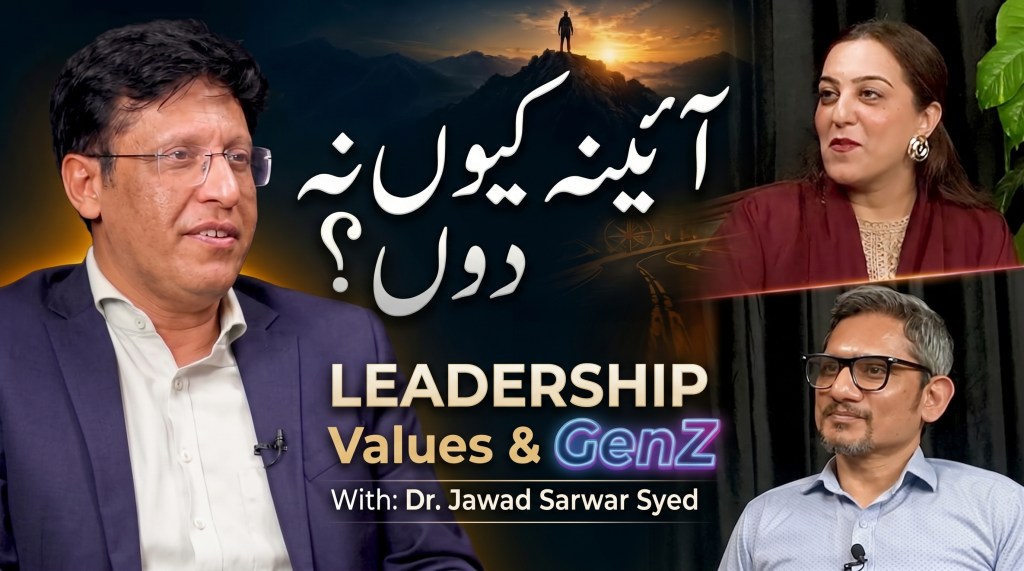
About the interviewee: Dr Jawad Sarwar Syed is Professor of Leadership and Organisational Behaviour at LUMS. His career has spanned engineering, the Pakistan Air Force, the private sector, and academic roles in Pakistan, the UK and Australia. He is also the author of Ayna Kiyun Na Doon, a collection of his own Urdu poetry. His poems explore themes including love, values and self-reflection.
About this resource: This resource draws on selected segments from an approximately 70-minute Urdu interview with Dr Jawad Sarwar Syed on Echoes of the Soul. The full conversation ranges across his professional journey, leadership, poetry, language, self-reflection, Gen Z and spiritual themes. For classroom use, the selected segments in this resource focus on values-driven leadership, diversity and Gen Z. Discussion questions accompany the selected segments. Summarized English subtitles are available.
Video published: 5 October 2026
Source: Echoes of the Soul (YouTube)
Task: Watch the interview clips at the suggested timestamps. Use the questions to discuss the speaker’s claims and examples, challenge them where appropriate, and connect them to your own experience.
Theme 1: Values-Driven Leadership
Watch (Timestamps): 10:40–15:40 and 21:15–26:30
- The interview contrasts values-driven leadership with leadership focused on holding on to power. How might the two differ in practice? What might employees observe in each case?
- A lack of competence and a lack of integrity are identified as major leadership problems in Pakistan and elsewhere. Can strength in one compensate for a deficit in the other? What consequences might either deficit have for an organisation?
- The interview contrasts success measured mainly through revenue and profit with alignment between values and practices. To what extent can such alignment contribute to a sustainable legacy?
- What would count as a worthy leadership legacy? How might it differ from financial results or length of time in office?
- The Ayna (mirror) metaphor is used to discuss self-examination and criticism. Why might leaders resist this “mirror”? What might help them receive criticism without responding with malice or vengeance?
- The interview argues for transparent processes and questions reliance on personal executive discretion. What are the benefits and possible limits of this position? How can organisations ensure that discretionary decisions are fair and accountable?
Theme 2: Diversity, Stereotypes and Gen Z
Watch (Timestamps): 27:10–28:40 and 32:40-42:45
7. The interview describes an exercise in which students identify a stereotype about a community and then look for examples that challenge it. How might this affect their assumptions? What are the exercise’s limitations, and what care should be taken when using it?
8. Blaming Gen Z and Gen Alpha is described as “the easiest and laziest” response. Do you agree? What experiences or evidence support or challenge this view?
9. What can leaders do to better understand and support younger colleagues? Consider the interview’s examples of patience, mentoring, interactive learning and adults examining their own screen habits. How can leaders do this while maintaining clear expectations?
Full interview:

