
Synopsis
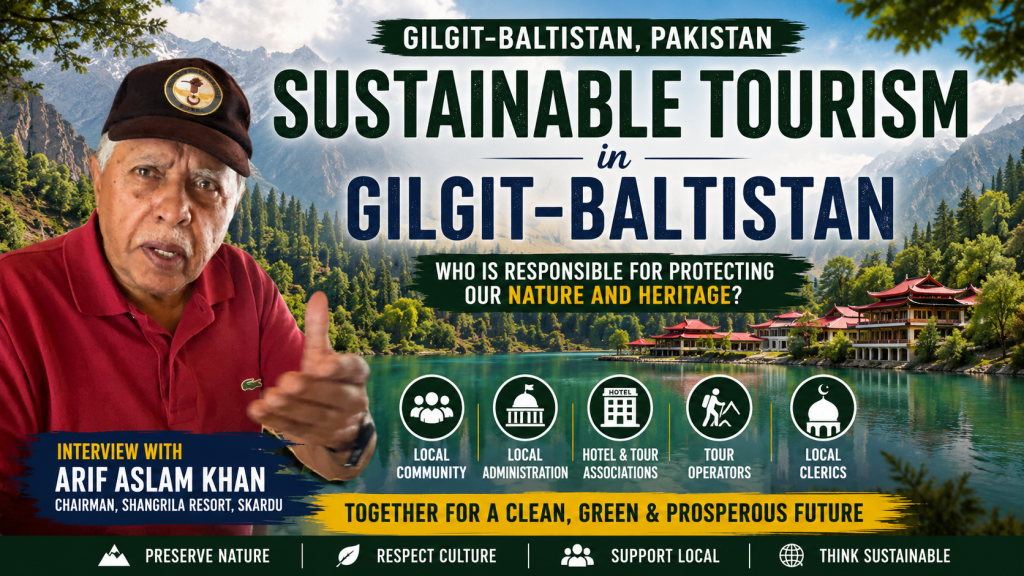
This interview features Dr Jawad Syed in conversation with Mr Arif Aslam Khan, Chairman of Shangrila Resort, Skardu, on the challenges and opportunities of sustainable tourism in Gilgit-Baltistan. The discussion argues that environmental degradation is driven not only by tourists but also by local stakeholders, including communities, hotel owners, government agencies, transport providers, and religious leaders. Mr Khan highlights issues such as unplanned construction, weak regulation, poor waste management, and short-term commercial interests, while proposing practical solutions including stronger governance, community awareness, architectural controls, fixed tourism standards, and university engagement. The interview emphasises collective responsibility for preserving the region’s natural and cultural heritage.
Video Link:
Video duration: 16 minutes
Intended Learning Objectives (ILOs)
By the end of this session (video review and discussion), participants should be able to:
- Analyse the responsibilities of different stakeholders in promoting sustainable tourism.
- Evaluate the governance and environmental challenges facing tourism in Gilgit-Baltistan.
- Assess the trade-offs between economic development and environmental conservation.
- Recommend practical strategies for responsible and sustainable tourism involving government, businesses, communities, universities, and civil society.
Indicative Discussion Questions
- Who bears the greatest responsibility for sustainable tourism in Gilgit-Baltistan: tourists, local communities, businesses, or government? Why?
- How can Gilgit-Baltistan balance tourism-led economic development with the protection of its natural environment and cultural heritage?
- Should stricter controls be introduced on hotel construction and land use around lakes, valleys, and mountain destinations? Why or why not?
- What role should local communities, religious leaders, universities, and tourism associations play in promoting responsible tourism?
- What lessons can other tourism destinations learn from the opportunities and challenges discussed in this interview?
- If you were advising the Government of Gilgit-Baltistan, what would be your top three policy recommendations for sustainable tourism?
Suitable Program and Course
Program: BBA, MBA, Executive Education
Course: Sustainability and Responsible Management; Business and Society; Strategic Management; Entrepreneurship; Tourism and Hospitality Management; Public Policy and Governance; Leadership and Stakeholder Management.
Citation: Syed, J. (2026). Sustainable tourism in Gilgit-Baltistan: Interview with Arif Aslam Khan. South Asian Academy of Management.

