
Synopsis
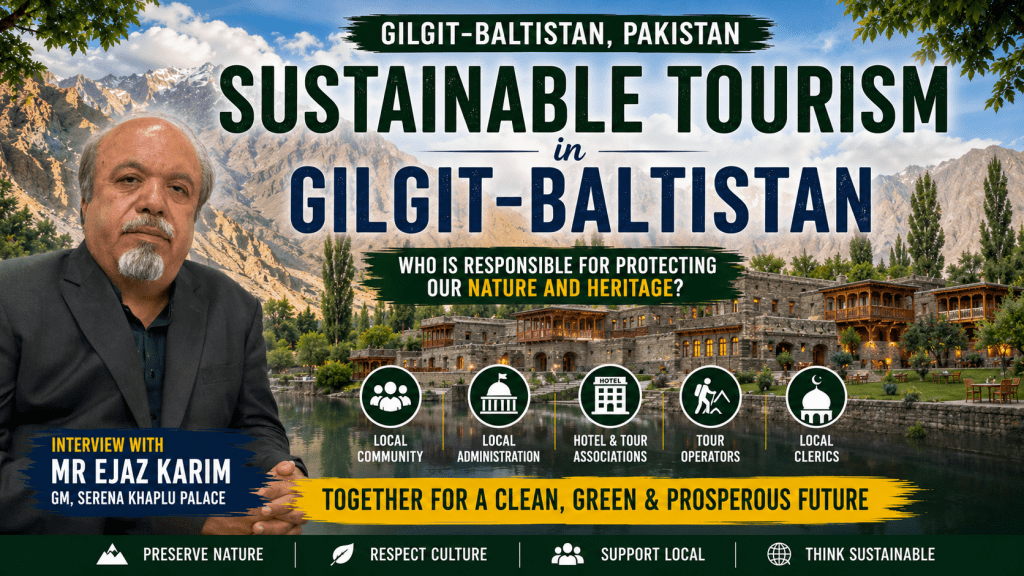
In this interview, Dr Jawad Syed (Professor, LUMS) speaks with Mr Ejaz Karim, General Manager of Serena Khaplu Palace, about the future of sustainable and responsible tourism in Gilgit-Baltistan. Mr Karim discusses the environmental pressures created by rapid tourism growth, unplanned construction, weak enforcement of regulations, and the region’s heavy dependence on tourism for livelihoods. He highlights the shared responsibilities of government, businesses, religious leaders, educational institutions, communities, families, and tourists in protecting the region’s natural and cultural heritage. The interview also explores practical solutions, including stronger governance, responsible tourism policies, youth education, public awareness, and sustainable destination management.
Video duration: 21 minutes
Intended Learning Objectives (ILOs)
By the end of this session, participants should be able to:
- Analyse the key sustainability challenges facing tourism in Gilgit-Baltistan.
- Evaluate the roles of government, businesses, communities, and educational institutions in promoting responsible tourism.
- Assess policy and management strategies for balancing tourism development with environmental conservation.
- Recommend practical interventions to encourage sustainable tourism and long-term regional development.
Classroom Discussion Questions
- Why has tourism become both an economic opportunity and an environmental challenge for Gilgit-Baltistan?
- Should the Government of Gilgit-Baltistan impose stricter regulations on construction, land use, and tourism development? Why or why not?
- How can Gilgit-Baltistan diversify its economy beyond tourism while preserving local livelihoods?
- What role should schools, universities, families, and religious institutions play in promoting responsible tourism and environmental awareness?
- Should Gilgit-Baltistan prioritise fewer but more responsible tourists over increasing visitor numbers? Discuss.
- What lessons from destinations such as the Lake District or Machu Picchu could be adapted to the context of Gilgit-Baltistan?
Suitable Program and Course
Program: BBA, MBA, Executive Education
Course: Sustainability and Responsible Management; Business and Society; Strategic Management; Entrepreneurship; Tourism and Hospitality Management; Public Policy and Governance; Leadership and Stakeholder Management.
Citation: Syed, J. (2026). Sustainable and responsible tourism in Gilgit-Baltistan: Interview with Ejaz Karim. South Asian Academy of Management.

